Cowboy Praying at Christian Cross
A Quiet Moment That Stitches With Intention
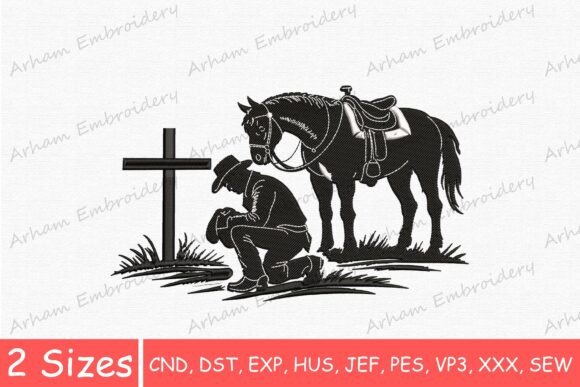
When I first opened Cowboy Praying at Christian Cross, I didn’t see just another religious embroidery file—I saw a mood. A grounded, reverent stillness. The composition balances simplicity and storytelling: a lone cowboy kneeling beside a wooden cross, head bowed, hands together. No background clutter. No ornate borders. Just focused line work, thoughtful negative space, and a posture that reads instantly—respectful, humble, human. It’s the kind of machine embroidery design that doesn’t shout; it invites pause. That makes it unusually versatile for real-world use—not as filler, but as meaning.
Where This Design Earns Its Place
I recently prepped Cowboy Praying at Christian Cross for a custom embroidered tote bag destined for a rural church fundraiser. Cotton canvas, medium weight, natural off-white. The design sat cleanly on the front panel—centered, not oversized, with breathing room around the figure. It looked handmade, not mass-produced. That’s key: this isn’t a flashy applique design meant for festival merch. It’s built for sincerity—nursery decor on a soft cotton pillow cover, a subtle chest embroidery on a men’s flannel shirt, a heartfelt baby onesie (paired with gentle script like “Faith Runs Deep”), or a framed patch sewn onto a denim jacket. Farm Amp’s quiet aesthetic shines here—not loud, not trendy, but rooted. It fits boutique branding for faith-based small shops, holiday embroidery for Christmas gift sets, or personalized gifts where emotional resonance matters more than visual noise.
What Holds Up—and What Needs Thought
Stitch-wise, Cowboy Praying at Christian Cross leans into clean satin stitch for the cross and key outlines, with balanced fill stitch for the cowboy’s hat and coat. Running stitch details are minimal but effective—just enough to suggest texture without overloading. That restraint pays off: it stitches reliably across fabric types. On a medium-weight sweatshirt? Solid. On a tea towel? Crisp. On a curved cap front? I’d recommend testing first—the pose’s verticality works better on flat or gently contoured surfaces than aggressively rounded ones.
That said, caution points are real. Avoid using it on thin fabrics (like lightweight rayon or delicate baby knits) without proper cutaway stabilizer—those fine lines in the hands and face can blur. On dark fabric, check thread color contrast early: light ecru or charcoal gray thread reads better than stark white for the praying hands. And while the design avoids tiny lettering or micro-details, the cross arms and folded fingers sit close to the edge of clarity at under 3 inches wide—so skip hoops smaller than 4×4 unless you’re confident in your machine’s precision and have verified the file’s smallest elements hold up in test stitching.
Design Decisions That Build Trust
Customers don’t buy embroidery files—they buy confidence in the finished product. Cowboy Praying at Christian Cross delivers that because it feels intentional, not algorithmic. There’s no forced symmetry or artificial embellishment. The proportions feel human-scale. That translates directly to buyer engagement: Etsy sellers report higher conversion when this design appears in clean, lifestyle-focused mockups—not generic white-background PNGs, but printable mockups showing it stitched on a worn leather journal or a linen apron. It signals care. It supports brand consistency for creative entrepreneurs who value authenticity over volume.
For commercial embroidery, it’s a safe bet—but only if licensed appropriately. Since Farm Amp doesn’t specify license terms here, I always advise double-checking before bundling it into digital embroidery file packs or selling finished embroidered patches at craft fairs. Clarity there protects your craft business long term.
Real Designer Notes—Not Theory
- Test first: Run it on scrap fabric matching your final project—especially if using textured weaves (like burlap or heavy twill) or stretchy blends.
- Stabilizer is non-negotiable: Medium tear-away works for stable cottons; switch to cutaway for knits or anything that moves during stitching.
- Check density: Look for any areas where fill stitch overlaps too tightly—especially near the cross base or coat folds. Overly dense sections can cause puckering on lightweight garments.
- Mock it both ways: View your digital embroidery file in black-and-white mode and on both light and dark fabric previews. Does the silhouette hold? Does the posture read clearly at small scale?
- Thread choice changes everything: Try matte cotton for rustic appeal (think aprons, tea towels), or smooth polyester for durability on sweatshirts and tote bags.
- Inspect corners and curves: Zoom in on the file itself—do the knees and cross arms stitch smoothly, or do they rely on auto-digitized jagged paths? Clean digitizing shows in the finished product.
Final Stitch: Who Is This For?
Cowboy Praying at Christian Cross isn’t for everyone—and that’s its strength. It’s for the Etsy seller who curates meaningful, not merely marketable, designs. For the small shop owner building a collection of faith-rooted handmade products—not slogans, but symbols with soul. For the apparel decorator who knows a well-placed, quietly powerful embroidery file on a men’s chore coat or a child’s backpack says more than ten trend-chasing graphics. It’s for the maker who understands that sometimes, the most professional thing you can do is choose restraint.
If your goal is fast-turnaround, high-volume custom apparel with bold impact, look elsewhere. But if you’re crafting personalized gifts, boutique merchandise, or heirloom-style nursery decor where emotional resonance and stitching integrity matter—Cowboy Praying at Christian Cross earns its place. Not as decoration, but as intention made tangible—one thoughtful stitch at a time.